The brief
The ASME competition sets a hard constraint before it sets a goal: build a flying quadcopter, and keep the whole team spend under $150. That budget is the design driver. It rules out most off-the-shelf frames and pushes the structure onto the 3D printer, where material is nearly free but strength has to be earned through geometry rather than bought.
The frame
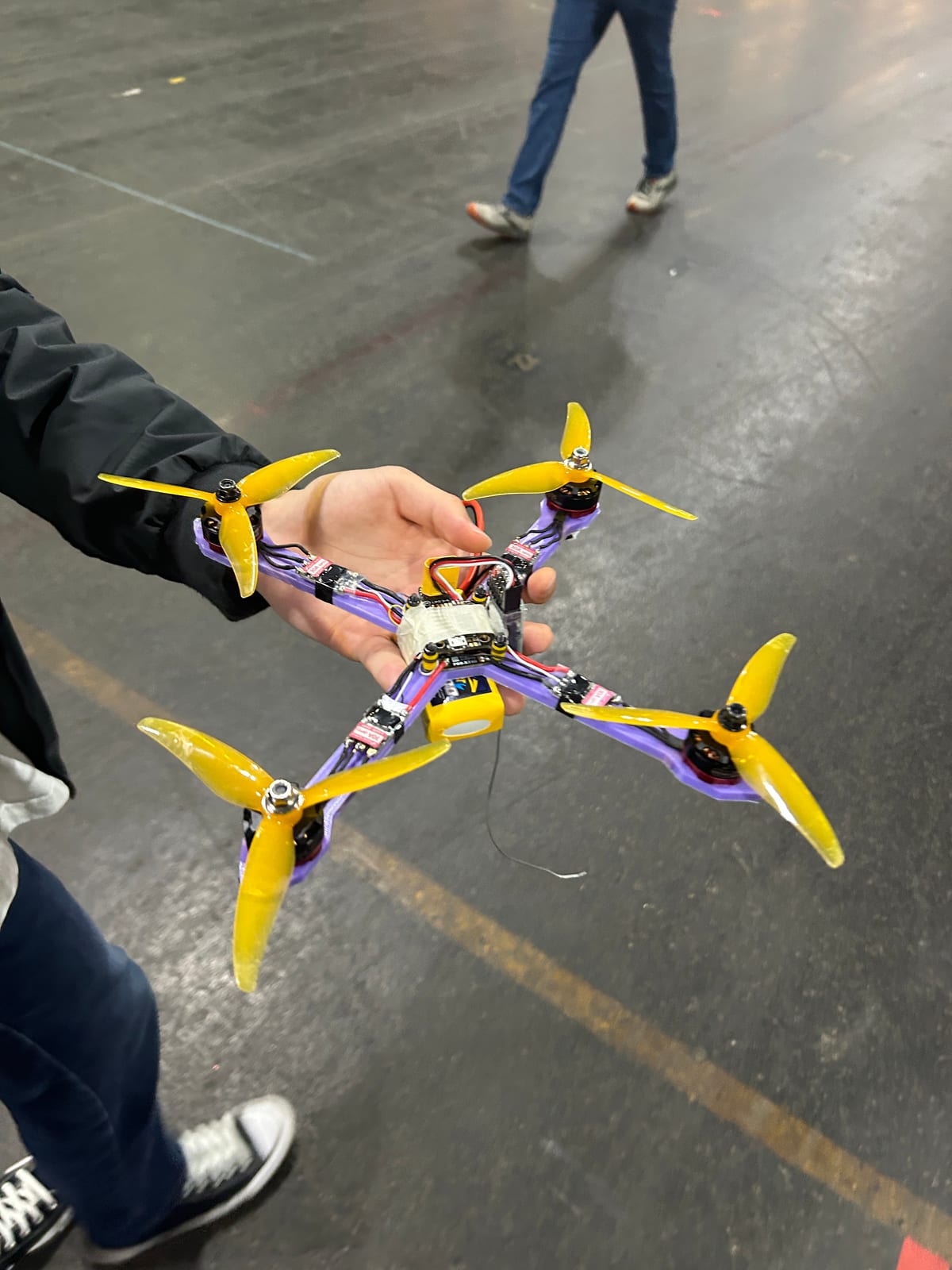
The frame was modelled in Fusion 360 and printed. Because a printed part is only as strong as where you put the plastic, the geometry went through FEA to find where load actually concentrates — the motor arms and the centre plate — and to thin everything that wasn’t carrying it. The aim was the lightest frame that still cleared its factor of safety under motor thrust, since on a drone every gram of structure is a gram the propulsion has to lift.
Sizing the propulsion
The battery wasn’t guessed. Starting from the motors’ current draw at full throttle, we sized the pack to a target endurance, which set a 10-minute flight time at full throttle from the chosen cells. Working from the motor specifications rather than a rule of thumb is what kept the endurance a number we could stand behind instead of a hope.
Outcome
The build flew and the team placed 3rd of 10. This was a team effort; my contribution sat on the mechanical side — the frame and the propulsion sizing — rather than the flight electronics or controls. What it taught cleanly is how a single hard constraint, the $150 budget, propagates into every downstream decision: material choice, where the structure lives, and how much battery you can afford to carry.