The brief
The assignment was to design a piece of jewelry for Selective Laser Melting in Inconel 718 — not a ring you could have cast or machined, but one that only makes sense because it’s grown layer by layer from powder. So the real subject wasn’t the ring. It was the process: what geometry SLM unlocks that subtractive manufacturing can’t touch, and what it costs you in support structure to build it. I led a three-person team, and the design went through seven Blender iterations. Four of them tell the story.
The iteration story
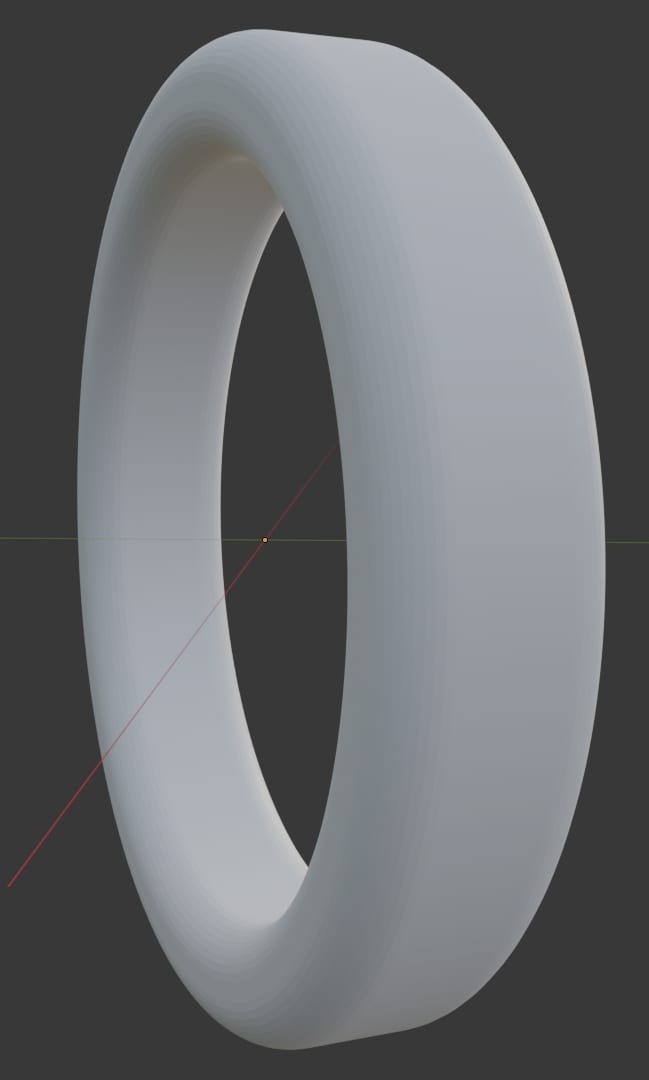
Start solid. The baseline is a plain band — the thing every later design defines itself against. Its only job is to be the mass we then tried to remove and the surface we then tried to complicate.
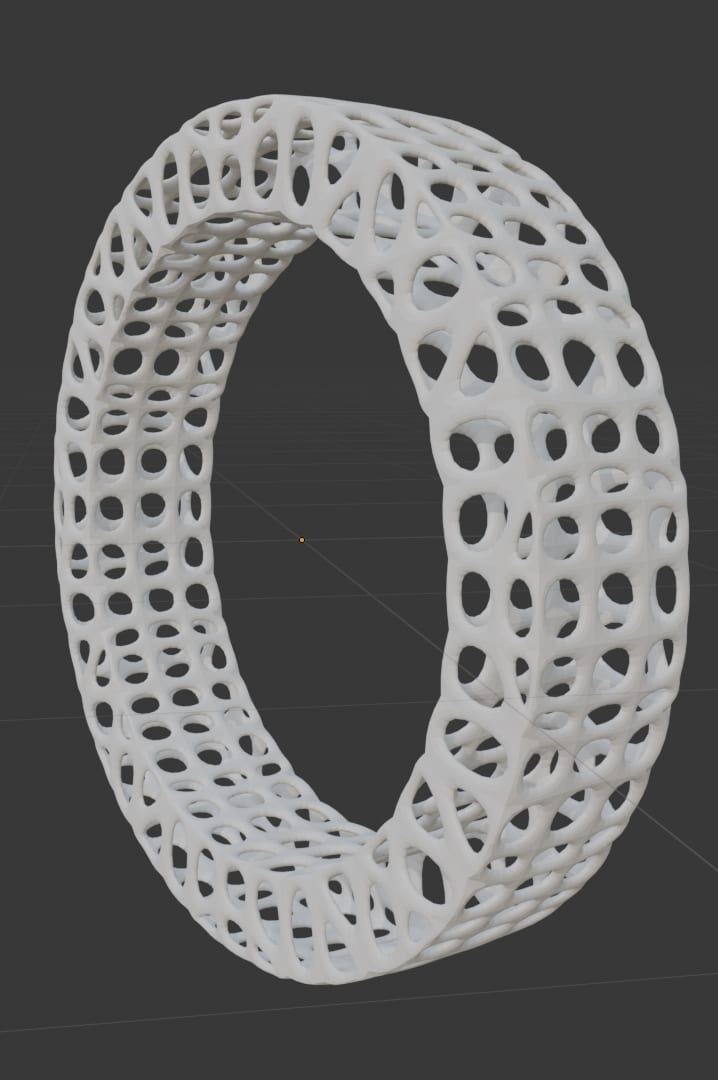
Open it into a lattice. The first real SLM move is to replace solid metal with an open lattice: a network of struts and voids that keeps a load path while dropping mass. This is the geometry the process exists to make — a cast band can’t have a lattice through its wall, and a mill can’t reach inside one.
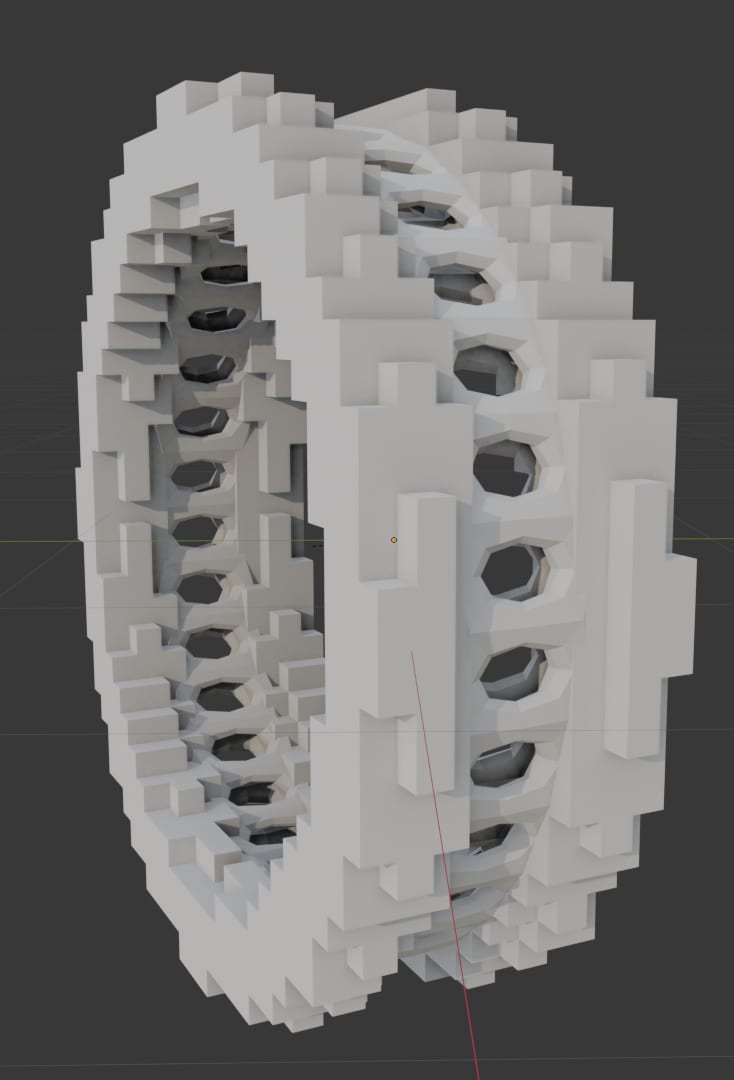
Try a block-difference approach. The lattice is elegant but hard to control parametrically. So the next branch built the porosity a different way: define the band, define a field of blocks, and boolean the blocks out of the band. At a coarse voxel size the result is deliberately chunky — a stair-stepped, blocky ring where the method is legible in the surface.
Refine the voxel. Shrinking the voxel keeps the parametric control of the block-difference method but pulls the result back toward the smoothness of the lattice — smaller holes, a denser and more even band. This is the design converging: the controllability of booleans with a finish approaching the lattice branch.
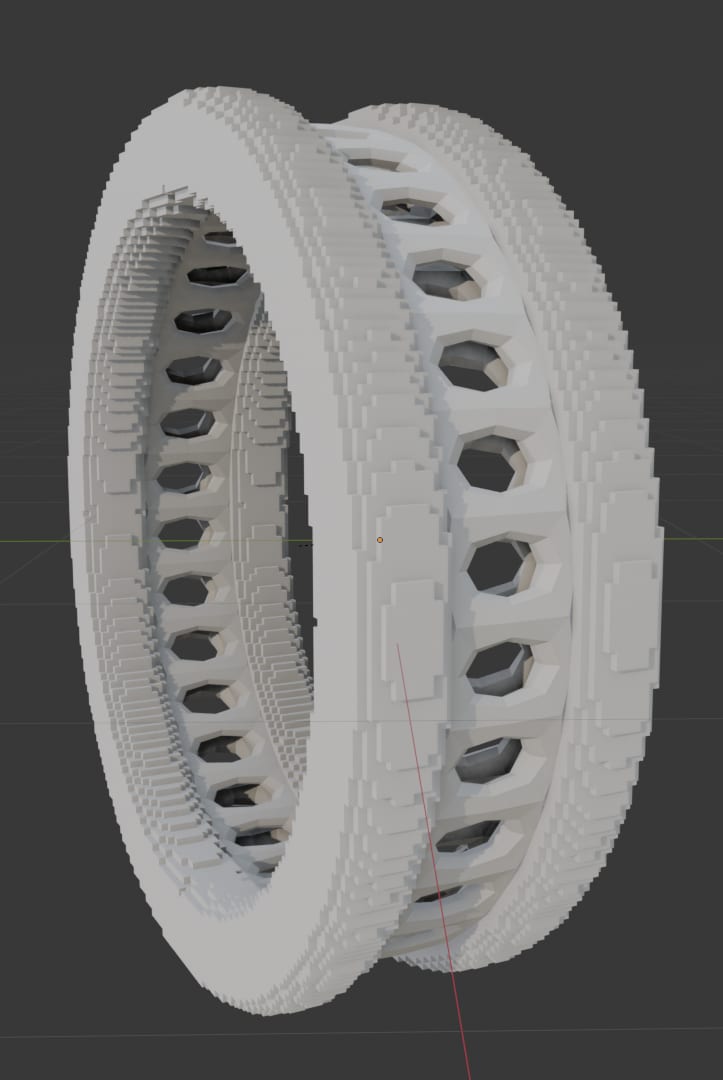
Two ways to make a porous ring — a hand-built lattice and a boolean of blocks — and the interesting part is that they converge. The block-difference method just needed its voxel shrunk to arrive near where the lattice already was, but with a parameter you can dial.
Designing for the build, not just the render
A geometry that looks good in Blender still has to survive the SLM build plate, and there the enemy is support structure: overhangs below a critical angle need scaffolding that wastes powder and has to be cut off afterward. Choosing the build orientation and tuning overhang angles so the lattice largely supports itself cut the slicer’s support-structure volume by 90% — less powder burned, less post-processing, and less surface damage where supports would have touched the piece. The plan also staged a laser surface-finishing pass to clean up the as-built texture that SLM inevitably leaves.
What it taught
The project is really a study of a process through one small object. Two routes to the same porous geometry, a boolean method that converges on a hand-built lattice once its resolution is high enough, and a support-structure win that comes entirely from how you orient the part on the plate — designing for SLM, not just designing something and printing it.